



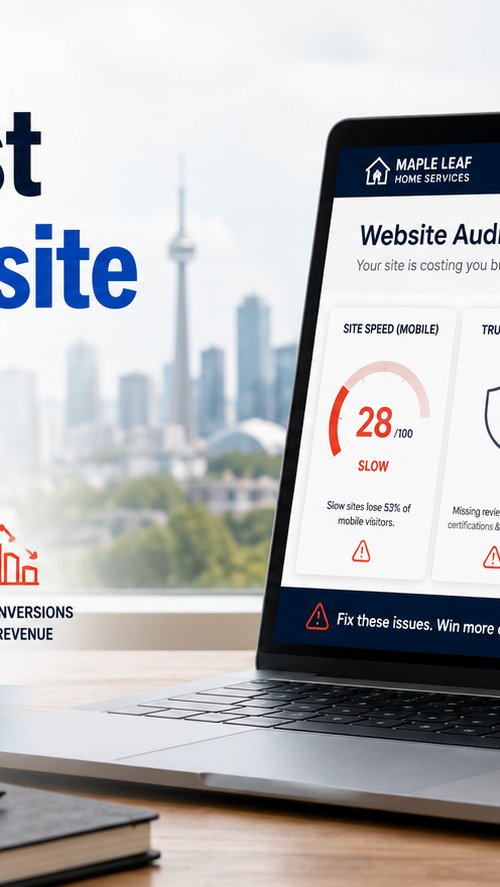
The Real Cost of a Bad Website (What You're Losing Without Knowing It)
A bad website doesn’t announce itself. It doesn’t crash. It doesn’t send you an error message. It doesn’t call to tell you a customer just left. It just quietly turns people away, one visitor at a time, every single day — and because nobody complains, most business owners have no idea it’s happening.
This post puts a number on that silence. Not using Amazon or Walmart statistics that feel abstract to a small business in Brampton or Whitby — but using realistic numbers for a GTA local service business getting a modest amount of local traffic. The math is sobering.
The Silent Revenue Leak
Consider a fictional but realistic small business: a renovation contractor in Vaughan. They get around 400 visitors a month to their website — a mix of Google searchers, referrals who looked them up, and people who found them on Google Maps. They average about $8,000 per job and close roughly one in ten inquiries into a paying client.
Their website loads in about 5 seconds on mobile. It was built four years ago on WordPress. It looks dated. There’s no phone number in the header, the contact form hasn’t been tested in a year, and there are no testimonials anywhere on the site.
Here’s what that actually costs them, conservatively:
The Hidden Cost Breakdown
Based on 400 monthly visitors, $8,000 average job value
Slow load time (5 sec mobile)
At 5 seconds, roughly 60% of mobile visitors leave before the page finishes loading. That’s ~240 people per month who never see your content, your phone number, or your work.
No trust signals (no testimonials, no portfolio)
Of the 160 visitors who do stay, a meaningful portion leave without contacting because there’s no evidence you’ve done this work before. Conservatively, this costs another 30% of remaining visitors.
No visible phone number / friction in contact
Of the 112 visitors still engaged, some percentage who were ready to call can’t find the number quickly on mobile and don’t complete the contact form. Conservatively, another 20% lost here.
Visitors who actually make contact
Of the original 400, roughly 90 people get to the point of contacting you. Without these problems, it would have been closer to 400 x a 5–10% contact rate = 20–40 contacts.
Monthly revenue impact
At a 10% close rate on contacts, that’s roughly 1 client per month from the website. With a well-performing site, it could reasonably be 2–4. The difference: 1–3 additional jobs per month.
These numbers are illustrative estimates, not guarantees. Actual results depend on your market, competition, and how well the site is built. But the direction is consistent: every friction point in your site is a multiplier applied to every visitor who encounters it.
The contractor isn’t failing. They have a working website. They’re getting traffic. But between the slow load time, the missing trust signals, and the friction in the contact process, they’re converting a fraction of the visitors who were genuinely interested in their service.
And none of these visitors call to explain why they left. They just find the next contractor on the search results page — one who happens to have a faster, clearer site — and they hire them instead.
The Costs That Are Even Harder to See
The calculation above only accounts for visitors you already have. A bad website also suppresses the number of visitors you get in the first place — which is the harder cost to quantify but arguably the larger one.
Rankings you never achieve
Google uses page speed, Core Web Vitals, mobile experience, and content quality as ranking signals. A slow, thin, template-based site ranks lower for local search terms than a fast, custom-built, locally optimized one. For a renovation contractor in Vaughan, the difference between ranking on page one and page two for “renovation contractor Vaughan” isn’t a small one — the first page gets over 90% of all clicks. The second page gets almost none.
If your site’s technical problems are keeping you off page one, you’re not just converting poorly — you’re largely invisible to people who are actively searching for exactly what you do, in the exact area you serve, right now.
Referrals that don’t convert
Every referral your happy clients send your way will Google your name before they call. If what they find is a slow, dated, or sparse website — or no website at all — some percentage of those referrals will hesitate. The person who referred you already did the trust-building work. Your website either confirms it or undermines it. A bad website is leaking referral conversion at a rate you’ll never see in any report.
The compounding SEO gap
Every month a competitor with a well-built website operates, they’re accumulating Google reviews, building backlinks, earning search visibility, and compounding their local rankings. Every month you’re operating with a poor site, that gap widens. Closing a six-month SEO gap takes longer than six months. Closing a three-year gap takes years. The cost of delay isn’t linear — it’s compounding.
What a “Fine” Website Actually Looks Like to Google
One of the most common things we hear from business owners is “my website is fine.” Usually what they mean is: it loads, it has my services listed, it has my phone number, and it doesn’t look broken.
Here’s what “fine” often looks like through Google’s lens:
Load time on mobile
PageSpeed mobile score
Core Web Vitals
Local SEO signals
Backlinks
Content freshness
A site that looks fine to you is often technically underperforming in ways that directly suppress your visibility and conversions. The only way to know for sure is to measure — which is why the PageSpeed test and Google Search Console are the starting points for any honest website audit.
The Cost of “Waiting Until Things Slow Down”
The most common reason business owners delay fixing their website is that things are good. Referrals are coming in, they’re busy, and a website project feels like something to tackle later. This is understandable — and also expensive.
The problem is that “later” usually means “when things slow down” — which is exactly the worst time to start building a web presence. SEO takes time. A new website doesn’t rank immediately. Getting reviews takes months. Building local authority is a slow process.
When a business starts this work from a position of urgency — because referrals have dried up, because a major client left, because a new competitor showed up — they’re building a life raft while treading water. The businesses that are in the best position are the ones that built the raft while the weather was calm.
The cost of a bad website isn’t just what you’re losing today. It’s the compounding cost of every month you don’t have the search visibility, the review base, and the conversion rate that a good website would have been building.
What the Fix Actually Costs
This is the part most posts on this topic avoid, so we’ll be direct about it.
A well-built small business website in the GTA costs roughly $3,000–$8,000 as a one-time build, or $150–$300/month on a subscription model. At AZP Systems specifically, our custom-coded sites start at $200/month with nothing down, or $3,500 as a one-time build.
Against the numbers above — even conservatively — the math is straightforward. If a better website generates one additional qualified inquiry per month for a business with an average job value of $5,000–$10,000, the cost of the website is recovered in the first month. Every subsequent month is net positive.
The question isn’t whether you can afford a good website. The question is how much longer you can afford a bad one.
Not Sure What Your Site Is Actually Costing You?
We’ll take a look at your current site, run the PageSpeed tests, check your local search visibility, and give you a plain-English assessment of where you stand and what it’s costing you. No obligation, no sales pitch — just an honest read.