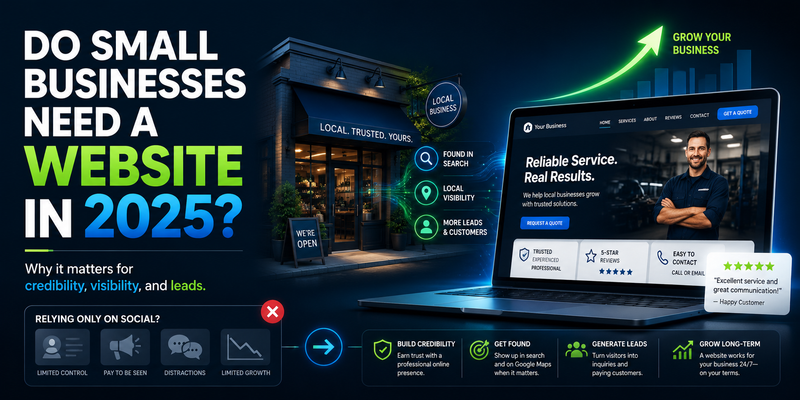
Do Small Businesses Need a Website in 2025?

It’s a fair question — and the honest answer is more nuanced than most articles will tell you. The short version: yes, most small businesses need a website. But the reasons why matter more than the yes itself. If you don’t understand why, you’ll either skip it when you shouldn’t, or build the wrong kind of site and wonder why it isn’t helping.
The Objections Worth Taking Seriously
Business owners who skip having a website usually have one of a few reasons. It’s worth addressing these honestly before making the case for why a website matters — because some of them are legitimate.
”I get all my business from referrals.”
This is the strongest argument for not having a website, and for some businesses it genuinely holds up. If you’re a contractor with a full calendar from word of mouth, a consultant with a steady client list, or a tradesperson who’s booked out three months ahead — you might not need a website right now. You’re not trying to be found. You’re serving the people you already know.
But here’s the catch: referrals don’t scale, and they aren’t reliable forever. Clients move, budgets change, referral networks dry up. When that happens, a business with no web presence starts from scratch. A business with an established website already has search visibility, a contact page, and something to point new prospects to. The best time to build a website is before you need it urgently.
”I just use Instagram / Facebook / Google Maps.”
Social media and Google Business Profiles are genuinely useful — and for some very local businesses (a coffee shop, a barbershop, a food truck), they can carry a lot of weight. But they come with a fundamental problem: you don’t own them.
Platforms change their algorithms, restrict organic reach, get hacked, or shut down accounts without warning. Instagram reduced organic reach for business accounts significantly over the past few years. Facebook pages that once had thousands of organic views now reach a fraction of followers without paid promotion. Google Business Profiles can be suspended for reasons outside your control.
A website is the only piece of digital real estate you actually own. It doesn’t change because a platform updated its algorithm. It doesn’t hide your content unless you pay to boost it. It’s yours.
”I don’t have the budget for it.”
This is worth taking seriously too. A bad website — one that looks amateur, loads slowly, or hasn’t been touched in three years — can actually hurt your credibility more than having no website at all. If the choice is between a $200 DIY site thrown together in an afternoon or nothing, the calculation isn’t as obvious as people assume.
That said, a good small business website doesn’t have to cost a fortune. A clean 5-page site that loads fast, looks professional, and makes it easy for people to contact you is all most local businesses need. That exists at accessible price points — including our own $200/month plan with no upfront cost.
Why a Website Matters More Than Most Business Owners Realize
People Research Before They Call
Over 80% of consumers research a business online before making a purchase decision or reaching out. This doesn’t just apply to ecommerce. Someone who got your number from a friend, saw your van on the street, or drove past your storefront will almost certainly Google your business name before calling — especially for anything that involves trust or significant spend.
If they can’t find you, or they find a thin Google Business profile with no website link, they hesitate. If they find a clean, professional website that explains what you do and why you’re the right choice — they pick up the phone with confidence. That’s the job of a website for most small businesses: not to drive traffic from strangers, but to convert warm leads who already found you some other way.
Your Website Works When You Don’t
A business that relies entirely on phone calls and in-person interactions only exists during business hours. A website answers questions, explains your services, displays your pricing, and provides a way to contact you at 11pm on a Sunday, on a holiday, during a busy week when you’re not answering the phone.
For service businesses in particular — plumbers, electricians, landscapers, cleaners, contractors — people often search when something has gone wrong. They’re not waiting for business hours. A website that’s there when they need it, with a clear contact form or phone number, captures leads that would otherwise go to a competitor who does have a site.
It Legitimizes Your Business
There’s a credibility gap between a business with a professional website and one without. It’s unfair — plenty of excellent businesses don’t have websites — but it’s real. When someone is comparing two contractors, two consultants, or two service providers, the one with a polished website signals that they’re established, serious, and invested in their business. The one without a website creates uncertainty.
This matters more for higher-ticket services. A customer deciding between two $150 haircuts might not care. A customer deciding between two $8,000 renovation quotes absolutely will.
Google Can Send You Customers — But Only If You Have a Site
A Google Business Profile gets you into the map results for local searches. That’s valuable and free, and you should have one regardless. But the businesses that rank highest in local search results — and appear in the organic results below the map — almost always have websites. A website gives Google something to crawl, index, and serve to people searching for what you do.
“Web design Toronto,” “plumber near me,” “best Italian restaurant Vaughan” — these searches happen constantly, and the businesses capturing them have websites optimized for those terms. Without a website, you’re invisible to anyone searching with intent to hire.
When a Website Can Wait
To be genuinely honest: there are situations where a website isn’t the priority right now.
You’re in early validation mode. If you’re testing whether a business idea has legs, spend your energy on getting your first 5 customers — not on a website. Talk to people. Do the work. Build a site once you’ve confirmed there’s demand.
You’re fully booked with no capacity to grow. If you can’t take more clients, a website that brings in more leads isn’t helping you — it’s creating work you can’t handle. Focus on capacity first.
Your entire market is offline. Some hyperlocal businesses — a market stall, a farmers’ market vendor, a school-run business — operate in spaces where online search isn’t how customers find them. Social media and in-person presence may genuinely be enough at that scale.
These are the exceptions. For the vast majority of small businesses trying to grow, attract new customers, and build long-term stability, a website is one of the highest-leverage investments you can make.
1
Home
Who you are, what you do, where you serve, and a clear call to action. Done in 60 seconds of reading.
2
Services
What you offer, explained clearly. Not a brochure — a page that helps people decide if you’re the right fit.
3
About
Who’s behind the business, how long you’ve been doing it, and why customers should trust you.
4
Testimonials / Work
Social proof. Real reviews, a portfolio, or case studies. This page does more for conversions than almost anything else.
5
Contact
A phone number, an email, a form, and your service area. Make it as easy as possible to reach you.
Five pages. Fast loading. Mobile-friendly. Easy to find on Google. That’s a website that does its job. You don’t need a blog, a resource library, an FAQ, or a live chat widget on day one. You can add those as your business grows. Start with what converts.
The Bottom Line
If you’re a small business trying to grow — attracting new customers, building credibility, and not being invisible when someone searches for what you do — you need a website. Not an elaborate one. Not an expensive one. Just a fast, clean, professional site that tells people who you are, what you do, and how to reach you.
The cost of not having one isn’t always visible. You don’t see the person who Googled your competitor and hired them instead. You don’t see the referral who looked you up, couldn’t find anything, and moved on. But they’re there — and they add up.
Ready to Build Yours?
At AZP Systems, we build clean, fast, hand-coded websites for small businesses across Toronto and the GTA — starting at $200/month with no money down, or $3,500 as a one-time build. We keep it simple: the pages that matter, the performance that helps you rank, and the support to keep it running.